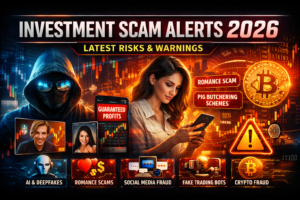
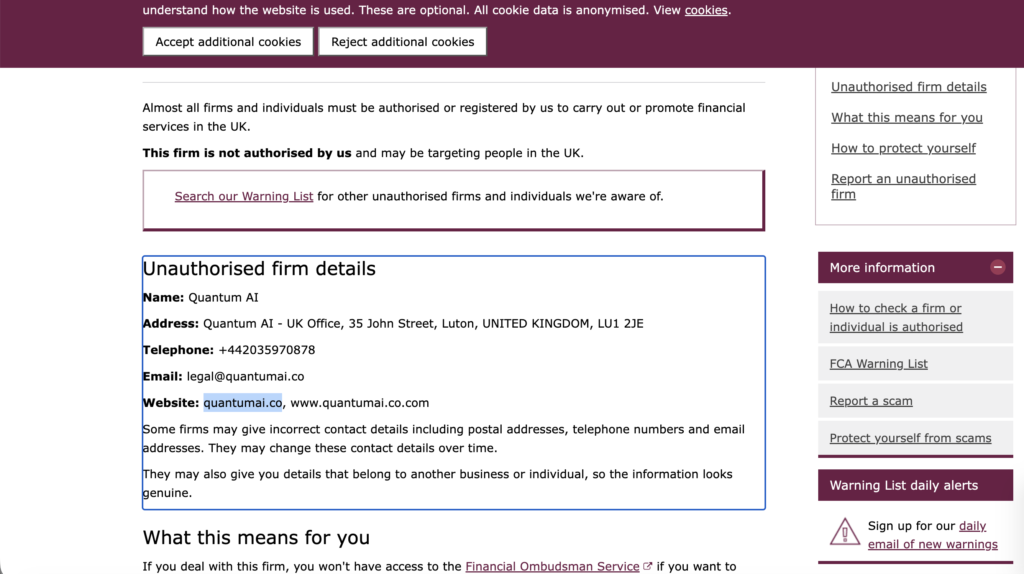
Quantum AI withdrawal issues are being reported at scale as part of one of the most extensively documented deepfake-driven investment scams currently active, with formal warnings issued by financial regulators across at least eight countries. If you’ve encountered ads featuring a celebrity apparently endorsing an “AI” or “quantum” trading platform and are now facing withdrawal problems, this is very likely the scheme in question or one operating on an identical model.
Quantum AI Withdrawal Issues — Regulatory Status
| Factor | Finding | Source |
|---|---|---|
| Regulatory authorization | Confirmed unauthorized in 8+ jurisdictions | FCA, ASIC, HK SFC, NZ FMA, Canada, NL AFM, CH FINMA, SE FI, DK DFSA |
| Marketing method | Deepfake celebrity endorsements | Which?, AI Incident Database |
| Withdrawal pattern | Blocked/restricted after deposit | NZ FMA direct finding |
| Documented losses | $8M+ (Australia, 2023 alone) | ACCC/ASIC |
This table lists confirmed regulator findings and named sources rather than a single composite score, so every claim here can be independently verified.
How the Scam Works
Scammers create lifelike AI-generated impersonations of celebrities and public figures who appear to promote “quantum” or “AI” online trading platforms, despite having no actual connection to those platforms or any awareness the ads exist. These typically take the form of fake news articles or social media videos showing a well-known figure describing how much money they made using the platform.
Consumer protection group Which? has tracked this scheme repeatedly, finding multiple deepfake videos including one using social media figure Andrew Tate in a fabricated podcast-style conversation used to promote Quantum AI on Meta’s platforms. Which? describes the mechanism plainly: it lures people in with promises of fast, easy money, and leaves them unable to withdraw returns or recover their funds once deposited. In one tracked wave, ads had been seen by nearly 12,000 accounts across Facebook and Instagram.
Regulatory Confirmation Across Jurisdictions
This is what separates Quantum AI from a typical unverified platform report the volume of independent, formal regulatory confirmation:
- Hong Kong SFC — issued a public warning naming “Quantum AI” directly as a fraudulent platform using deepfaked footage of Elon Musk
- Australia (ACCC/ASIC) — identified it as one of the most prolific online investment scams in the country, with losses exceeding $8 million in 2023
- New Zealand FMA — confirmed a specific domain as a scam platform that refuses withdrawal requests
- Canada — provincial securities commissions listed operators using aliases connected to the scheme as unregistered securities traders
- Netherlands, Switzerland, Sweden, Denmark — each issued formal warnings listing Quantum AI as unauthorized
Quantum AI Withdrawal Issues: The Pattern Behind Them
Multiple independent reviews describe a consistent operational sequence behind reported Quantum AI withdrawal issues: the platform runs multiple domain clones under the same brand, and manipulates displayed transaction data to create an illusion of profitability while preventing real withdrawals. The deposit phase works smoothly the failure point is specifically at withdrawal.
Why Deepfakes Make This Especially Effective
Unlike older scam ads relying on stock photos or fake testimonials, Quantum AI’s marketing exploits generated video and audio that closely mimics real public figures a meaningfully harder red flag for an average person to catch by instinct, since the cues people normally rely on to judge credibility are themselves fabricated. Regional coverage of the deepfake fraud landscape notes a steep rise in this specific attack style across Asia-Pacific markets, underlining that Quantum AI is one prominent example of a broader, fast-growing category.
Warning Signs Specific to Quantum AI
- Any ad or article featuring a celebrity “endorsing” an AI/quantum trading platform
- Multiple, frequently changing domain names operating under similar branding
- No registration or license found in any recognized regulator’s database
- Fabricated news articles designed to look like legitimate financial press
- Withdrawal difficulty appearing only after profitable-looking dashboard activity
What To Do About Quantum AI Withdrawal Issues
1. Don’t trust the celebrity endorsement
However convincing the video looks, no verification is possible from the video itself check independent regulator warning lists instead.
2. Stop sending money immediately
Do not respond to any request for further payment to “unlock” withdrawals.
3. Report the specific ad
Report to the platform it appeared on (Meta, in most documented cases) in addition to your national financial regulator ad-platform reporting has, in some tracked cases, led to takedowns of specific deepfake campaigns.
4. Check your regulator’s warning list directly
Rather than relying solely on a specific domain name, since Quantum AI is known to operate under multiple rotating URLs.
Encountered This Pattern On Another Platform?
Review our step-by-step guidance on documenting evidence and reporting suspicious platforms before taking further action.
Frequently Asked Questions About Quantum AI Withdrawal Issues
Is Quantum AI regulated anywhere?
No every regulator that has examined it, across at least eight countries, has confirmed it is unauthorized.
Was the celebrity in the ad really involved?
No. Every documented case involves AI-generated video the person never participated in or consented to.
Can I recover money I deposited?
Recovery is difficult and depends heavily on your payment method and how quickly you act. Treat any company guaranteeing recovery for an upfront fee with the same skepticism you’d apply to the original platform guaranteed recovery claims are themselves a known secondary-scam pattern.
Related Resources
- Top 10 Red Flags of Crypto & Forex Scams
- Steps To Take After Encountering A Suspicious Platform
- Lost Funds Recovery Guide
- Verify Online Investment Platforms
Research & Sources
This article was prepared using formal regulator warnings and independent investigative reporting, including:
- Australian Competition & Consumer Commission (Scamwatch)
- Which? investigative reporting on Meta ad campaigns
- Hong Kong Securities and Futures Commission public warning
- AI Incident Database (incidentdatabase.ai)
- Regulatory warnings from Canada, New Zealand, Netherlands, Switzerland, Sweden, and Denmark

Baja Maja
Research Author
Baja Maja is a research author at MarketDueDiligence.com, specialising in scam reviews, broker investigations, and financial risk analysis, with a focus on regulatory records, platform transparency, and real user experiences.
Last Updated: September 2026 | Category: Scam Awareness | Deepfake Fraud | AI Investment Scams
If you’re currently dealing with Quantum AI withdrawal issues, the most protective action is the simplest one: stop sending money, document everything, and report through the official channels linked above rather than any third party contacting you directly.
If you’ve lost money to a scam broker or platform, act now. Fill in the form below to get a free consultation with experts who may help you trace your funds.