Can’t Withdraw From PCEX? Here’s What The Evidence Shows

If you’re searching for answers about PCEX withdrawal issues, you’re not alone. Deposit money into PCEX and, according to a consistent body of user reports, the experience looks smooth: a dashboard, visible balance growth, encouragement to add more. Try to take that money back out, and a different pattern emerges one detailed enough, and reported widely enough, that New Zealand’s financial regulator has now blacklisted the platform by name.
How PCEX Withdrawal Issues Typically Unfold
An independent investigation into the platform describes users being encouraged to deposit cryptocurrency Bitcoin, Ethereum, or stablecoins after seeing fabricated account statistics suggesting strong returns. Deposits are then followed by more deposit requests, framed as unlocking premium features or taking advantage of market timing. The trouble starts at the withdrawal stage: attempts are met with excuses, and the investigation concludes withdrawals are ultimately disabled outright, since the operation’s purpose is retaining deposits rather than returning them.
What happens next is arguably the more useful warning sign for other investors: according to the same investigation, once users grow suspicious and start demanding withdrawals or threatening to involve authorities, the platform tends to vanish site taken down, social accounts deleted with operators reportedly resurfacing later under a new name and domain. If you’re looking for a single tell that separates a slow, bureaucratic delay from something more serious, this is it: legitimate compliance friction doesn’t end in the company disappearing.
The New Zealand FMA Blacklist Entry — Formal Evidence Behind The PCEX Withdrawal Issues
New Zealand’s Financial Markets Authority has gone further than an individual review site would it placed PCEX on its official blacklist, stating that multiple sites operating under the PCEX name form part of a coordinated investment scam network. The regulator’s notice describes fabricated trading results, falsified account balances, and blocked withdrawal attempts, with some victims told to pay additional “fees” or “taxes” first, without ever receiving their funds afterward. Where independent reviews rely on aggregated user reports, this is a formal government determination a materially different, and stronger, category of evidence behind the reported PCEX withdrawal issues.
Licensing Claims Don’t Hold Up
PCEX has referenced MSB (money services business) licensing in its own materials. An independent verification check found that claim doesn’t appear in the relevant licensing database at all. The same check cited a separate scam-detection service’s assessment giving the platform a low reliability rating and labeling it untrustworthy, alongside a pattern of marketing built on unrealistic, guaranteed-return promises a combination reviewers flag repeatedly across confirmed scam platforms, not just this one.
Is PCEX Connected to Other Known Scams?
Reddit discussion and at least one independent review have drawn a line between PCEX and two other platforms already confirmed as scams, LWEX and XUEX, citing shared site design and similar operational patterns. It’s worth stating plainly what this evidence does and doesn’t establish: it’s a pattern observation from users and reviewers, not a confirmed ownership or corporate link. Treat it as one more data point rather than proof of a coordinated entity the FMA blacklist finding and the withdrawal-pattern reports stand on their own regardless of whether this specific connection holds up.
Practical Steps If You’re Facing PCEX Withdrawal Issues
The single most consequential decision at this point is whether to send anything further. Every documented case reviewed here ends the same way when a user pays a requested “unlock” fee or tax: no funds follow. So that’s the starting point not because it’s generic advice, but because it’s the one action that appears to actually change outcomes in these reports.
From there, three things are worth doing in parallel rather than in sequence: pull together everything you have balance screenshots, support messages, deposit transaction hashes with timestamps before any of it becomes harder to access; file a report with the FMA (or your own country’s equivalent regulator) so the pattern gets added to an official record rather than staying anecdotal; and if any part of your deposit went through a card or bank transfer rather than crypto directly, contact that provider immediately, since that’s typically the only channel with a realistic dispute mechanism.
Not Sure What To Do Next?
We’ve broken down the reporting and documentation process in more detail here.
Common Questions About PCEX Withdrawal Issues
Does PCEX have any regulatory license?
Independent verification found no matching entry in the MSB licensing database it referenced, and New Zealand’s FMA has separately blacklisted the platform outright.
My account still shows a balance — does that mean my funds are safe?
Not necessarily. A visible, apparently growing balance is consistent with every case reviewed here up until the point of attempting a withdrawal — the dashboard figure and the actual accessible funds appear to be two different things.
I’ve heard PCEX is the same operation as CBEX — is that accurate?
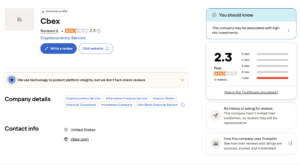
Not confirmed. Some users and reviewers note similarities and discuss a possible connection, but there’s no verified corporate link. CBEX has its own, considerably more extensive regulatory record, which we cover separately.
They’re asking for a tax payment before releasing my withdrawal — should I pay it?
Based on every account reviewed here, no. This specific request precedes total loss far more often than it precedes a successful withdrawal.
Related Resources

Baja Maja
Research Author
Baja Maja is a research author at MarketDueDiligence.com, specialising in scam reviews, broker investigations, and financial risk analysis, with a focus on regulatory records, platform transparency, and real user experiences.
Sources: New Zealand Financial Markets Authority blacklist notice; independent platform investigation (malwaretips.com); MSB licensing and trust-score verification (trustfinance.com); user reports via Reddit and lycanretrieve.com. Last updated September 2026.
If you’ve lost money to a scam broker or platform, act now. Fill in the form below to get a free consultation with experts who may help you trace your funds.